A Comprehensive Analysis of Aramid Fibers: Properties, Applications, and Future Development
2026-01-28 15:03
Introduction to Aramid
Aramid fiber is a linear polymer composed of aromatic and amide groups. It possesses not only excellent mechanical properties but also a stable chemical structure and ideal mechanical properties.
These characteristics endow aramid fiber with numerous advantages, including ultra-high strength, high modulus, high temperature resistance, acid and alkali resistance, light weight, and wear resistance.
Unlike the molecular chains of ordinary flexible polymers, the main chain structure of aramid fiber is based on the para-position of benzene rings, forming a rod-like molecular structure.
This unique molecular structure makes it difficult for the molecular chain segments to undergo internal rotation, thus exhibiting a linear rigid structure.
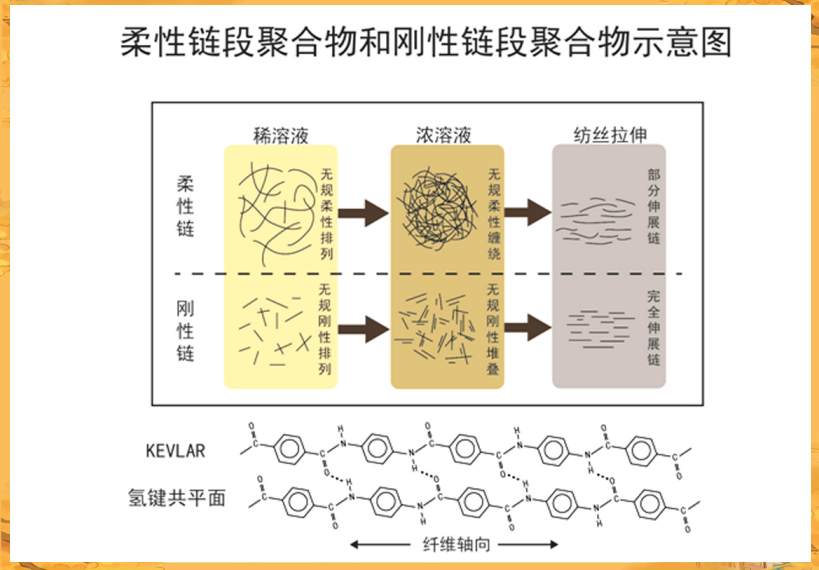
Aramid fibers also exhibit a variety of supramolecular structures, including core-sheath structures, subcrystalline structures, and microfiber structures. The crystallinity of the fiber sheath is lower than that of the core, and the sheath thickness varies depending on the fiber type and spinning process, typically ranging from 0.1 μm to 1 μm.
The core consists of single crystals arranged along the fiber axis, with a slightly lower degree of orientation than the sheath. The molecules in the fiber are almost parallel to the fiber axis in the longitudinal direction, while in the transverse direction they are radially oriented parallel to the hydrogen bond sheets.
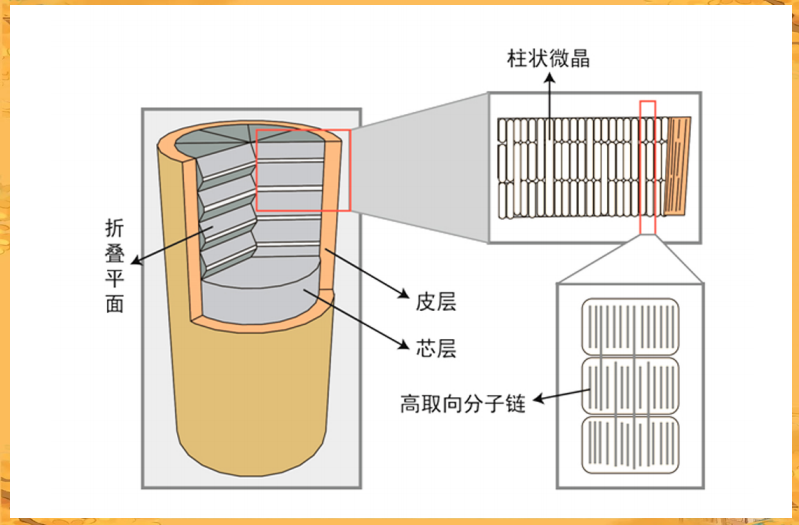
On the other hand, meta-aramids, represented by poly(m-phenylene isophthalamide) (PMTA) fibers, lack the conjugation effect of covalent bonds in their molecular chains, resulting in lower rotational potential energy within the molecular chains. The macromolecular chains are more flexible than para-aramids, and the fibers also have lower crystallinity.
Applications of aramid fibers
Para-aramid fibers, with their excellent ballistic protection properties, play a key role in the field of military protection,It is also often used as a reinforcement in composite materials, blended with carbon fiber, glass fiber, etc.
Aramid pulp, a highly fibrillated fiber, has a high specific surface area and unique tensile strength and low density properties, making it an ideal reinforcing material in resins, rubbers and other matrices.
The application of meta-aramid fibers means that fabrics made from these fibers play a vital role in industries such as manufacturing, military, firefighting, and motorsports.
Summary and Outlook
Aramid-reinforced pipes have demonstrated significant advantages in the oil and gas pipeline sector, effectively replacing traditional steel pipes and thus preventing leaks caused by corrosion. Furthermore, their lightweight nature simplifies transportation and installation.
The future technological research and development focus of my country's aramid enterprises will be concentrated on the following aspects: improving the performance of aramid through copolymerization modification, optimizing processing and production conditions and reducing fiber costs; and enabling aramid to adapt to different application needs through surface modification, blended fibers and new molding technologies, while improving performance and reducing application costs.
Related News
Read More >-
![70g/m² Heavy-Duty Non-Woven Glass Mat for Architectural Acoustic Panels, Mineral Wool Tiles, and Perforated Ceilings]()
70g/m² Heavy-Duty Non-Woven Glass Mat for Architectural Acoustic Panels, Mineral Wool Tiles, and Perforated Ceilings
SAAT70 is a wet-laid non-woven fiberglass acoustic tissue engineered for high-performance sound absorption panels and architectural acoustic ceilings. We manufacture this dense fiberglass tissue as a primary acoustic facing veil that controls airflow resistance (AFR) while masking dark mineral wool and glass wool fibers.
-
![25g/m² Ultra-Thin Non-Woven Glass Mat for Substrate Reinforcement in PVC Flooring and Decorative Wallpapers]()
25g/m² Ultra-Thin Non-Woven Glass Mat for Substrate Reinforcement in PVC Flooring and Decorative Wallpapers
The light 25g/m² matrix holds exact machine tension under high-temperature PVC gelation ovens up to 200°C. Factory lines integrate SAFT25 into vinyl sheet flooring and vinyl-faced wall coverings to prevent edge curling, thermal shrinkage, and surface tearing during high-speed lamination
-
![25g/m² Ultra-Thin Glass Fiber Mat for Organic Waste Gas Adsorption and Air Purification Substrates]()
25g/m² Ultra-Thin Glass Fiber Mat for Organic Waste Gas Adsorption and Air Purification Substrates
The light 25g/m² matrix maintains uniform air permeability while providing high thermal resistance up to 260°C. Factory lines integrate SAFT25 into pleated filter elements, honeycomb adsorption wheels, and industrial exhaust gas scrubbers to optimize gas capture without driving up system pressure drop
-
![50g/m² Non-Woven Glass Mat for Primary Backing and Dimensional Stability in Modular Carpet Tiles]()
50g/m² Non-Woven Glass Mat for Primary Backing and Dimensional Stability in Modular Carpet Tiles
The 50g/m² matrix holds tight web tension during high-temperature PVC paste coating and hot bitumen impregnation up to 180°C. Factory lines integrate SACT50 directly between secondary backing layers to stabilize modular tile geometry and eliminate field returns caused by dimensional shifting
-
![50g/m² Functional Coated Mat for Polyisocyanurate (PIR/PUR), Rock Wool, and EPS Outer Wall Insulation Boards.]()
50g/m² Functional Coated Mat for Polyisocyanurate (PIR/PUR), Rock Wool, and EPS Outer Wall Insulation Boards.
The 50g/m² matrix features a functional polymer coating that blocks foam chemical strike-through, maintains web tension under continuous heat pressing up to 200°C, and ensures superior mortar keying on job sites.
-
![30g/m² Fiberglass Tissue for Inner and Outer Surface Treatment of FRP Products]()
30g/m² Fiberglass Tissue for Inner and Outer Surface Treatment of FRP Products
We produce this Fiberglass Surface Tissue to form a resin-rich layer on the inner corrosion-resistant lining and outer surface of FRP tanks, pipes, and pultruded profiles, preventing resin cracking under thermal stress.
-
![SART50 Fiberglass Roofing Tissue to Reduce Asphalt Membrane Production Scrap]()
SART50 Fiberglass Roofing Tissue to Reduce Asphalt Membrane Production Scrap
We make this Fiberglass Tissue to carry asphalt during continuous hot dipping and lamination runs.The 50g/m² matrix holds roll tension under high temperatures, stops edge tears, and controls binder loss in hot bitumen dip tanks up to 200°C.
-
![The Industrial Value of Polyimide Wet-Laid Nonwovens]()
The Industrial Value of Polyimide Wet-Laid Nonwovens
Polyimide fiber wet-laid nonwoven fabric is the ideal fiber material for making fire-retardant clothing such as protective suits for armored forces, racing suits, and flight suits. It can also be used to manufacture comfortable and warm functional clothing.