Quartz Fiber Yarn: The "Special Forces" of the Materials World You Didn't Know About
2026-03-24 14:28
Leveraging its characteristics including high-temperature resistance up to 1700°C, exceptional insulation, and corrosion resistance quartz fiber yarn has emerged as a critical material in the fields of 5G communications, semiconductors, and new energy, driving innovation across these industries.
1. Basic Characteristics of Quartz Fiber Yarn
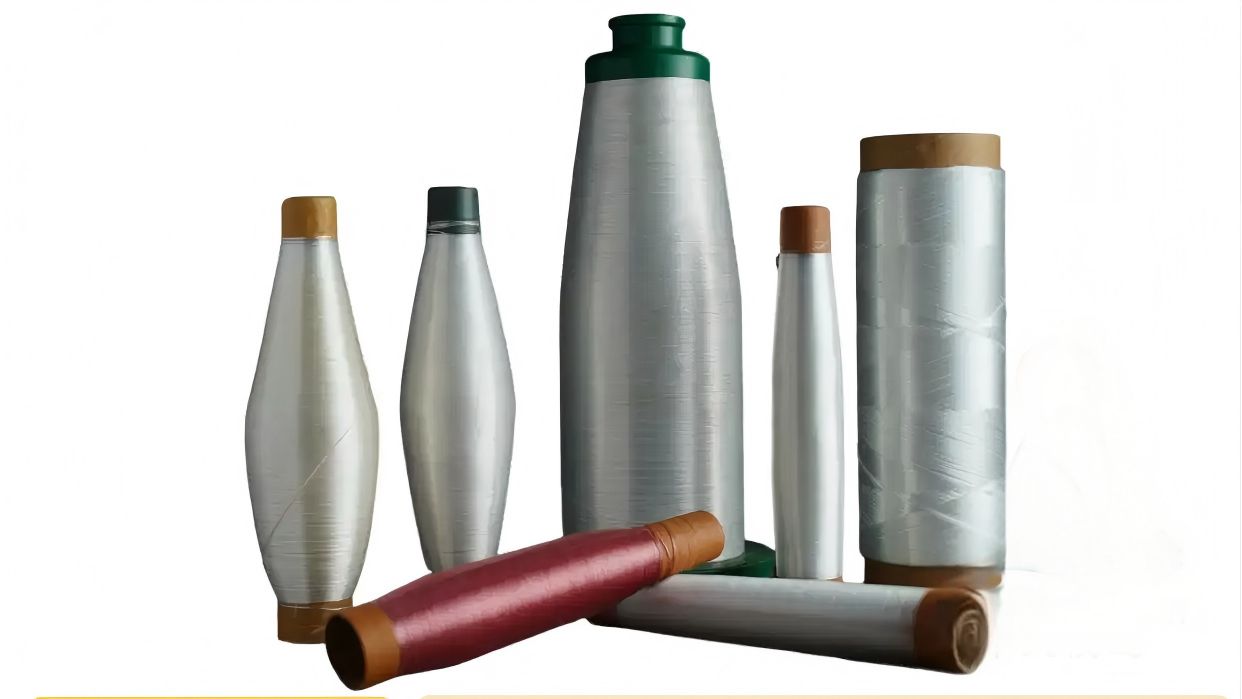
Quartz fiber yarn is a continuous fiber produced by melting and drawing high-purity silicon dioxide.
Its key characteristics include:
Ultra-High Temperature Resistance
It possesses a softening point as high as 1700°C, with a long-term service temperature reaching up to 1050°C.
It features an extremely low coefficient of thermal expansion (0.54 × 10⁻⁶/°C) and excellent thermal shock resistance, making it suitable for extreme temperature environments.
Excellent Electrical Insulation Properties
It exhibits a low dielectric constant (3.74) and minimal dielectric loss (0.0002), making it ideal for use in high frequency electronic equipment.
Exceptional Chemical Stability
It demonstrates resistance to strong acids (with the exception of hydrofluoric acid), resistance to bases (though not strong bases), and resistance to oxidation, rendering it suitable for corrosive environments.
High Strength and Low Density
With a tensile strength of 3600 MPa and a tensile modulus reaching up to 78 GPa surpassing that of ordinary glass fibers it possesses a density of only 2.2 g/cm³, offering distinct advantages in lightweight applications.
Excellent Electromagnetic Wave Transparency
It causes virtually no attenuation of electromagnetic waves, making it an ideal material for wireless communication applications.
2. Manufacturing Process of Quartz Fiber Yarn
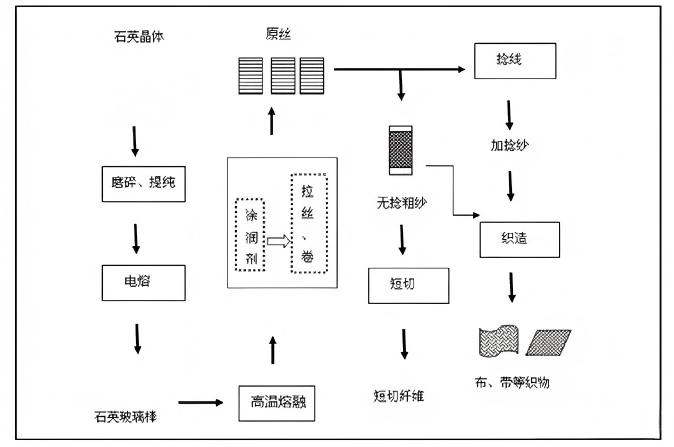
The preparation of quartz fiber yarn primarily involves the following key steps:
Raw Material Purification
High-purity quartz sand is utilized to produce ultra-high-purity SiO₂ (purity ≥ 99.95%).
Melting and Drawing
Quartz is melted in a high-temperature electric furnace and drawn through a spinneret to form continuous fibers.
Surface Treatment
A high-temperature-resistant sizing agent (such as a silane coupling agent) is applied to enhance the bonding strength between the fibers and the resin matrix.
Yarn Formation
Through processes such as twisting and plying, yarns of various specifications are produced, suitable for weaving, braiding, or filament winding applications.
3. Analysis of Application Fields for Quartz Fiber Yarn
Electronics and Information Technology: 5G Communications and Semiconductor Manufacturing
High Frequency Circuit Substrates: Used in 5G base stations and communication equipment to minimize signal loss.
Semiconductor Equipment: Used to fabricate corrosion-resistant components for plasma etchers, thereby reducing metal contamination.
New Energy: Batteries and Hydrogen Energy Storage & Transport
Lithium Battery Separator Reinforcement: Enhances battery safety and prevents thermal runaway.

As a key strategic material of the 21st century, quartz fiber yarn is driving innovation across industries such as new energy and electronic information. Its unique combination of properties endows it with irreplaceable advantages in extreme environments and high-end applications. Looking ahead, as manufacturing technologies advance and application scenarios expand, quartz fiber yarn is poised to shine brightly in an even wider array of fields, emerging as the "rising star" of the high-performance materials sector.
Related News
Read More >-
![30g/m² Fiberglass Tissue for Inner and Outer Surface Treatment of FRP Products]()
30g/m² Fiberglass Tissue for Inner and Outer Surface Treatment of FRP Products
We produce this Fiberglass Surface Tissue to form a resin-rich layer on the inner corrosion-resistant lining and outer surface of FRP tanks, pipes, and pultruded profiles, preventing resin cracking under thermal stress.
-
![SART50 Fiberglass Roofing Tissue to Reduce Asphalt Membrane Production Scrap]()
SART50 Fiberglass Roofing Tissue to Reduce Asphalt Membrane Production Scrap
We make this Fiberglass Tissue to carry asphalt during continuous hot dipping and lamination runs.The 50g/m² matrix holds roll tension under high temperatures, stops edge tears, and controls binder loss in hot bitumen dip tanks up to 200°C.
-
![The Industrial Value of Polyimide Wet-Laid Nonwovens]()
The Industrial Value of Polyimide Wet-Laid Nonwovens
Polyimide fiber wet-laid nonwoven fabric is the ideal fiber material for making fire-retardant clothing such as protective suits for armored forces, racing suits, and flight suits. It can also be used to manufacture comfortable and warm functional clothing.
-
![Wet-laid nonwovens are rapidly penetrating the high-end application market, driven by their superior performance.]()
Wet-laid nonwovens are rapidly penetrating the high-end application market, driven by their superior performance.
-
![What makes quartz fiber needle-punched felt the new benchmark for thermal insulation materials?]()
What makes quartz fiber needle-punched felt the new benchmark for thermal insulation materials?
With a temperature resistance limit of 1050°C, an ultra-low thermal conductivity of 0.03 W/(m·K), 30% compressibility and resilience, and 99.95% purity, quartz fiber needle-punched felt is sparking a thermal insulation revolution in the photovoltaic and semiconductor sectors.
-
![High-Performance Quartz Fiber Wet-Laid Nonwovens for Extreme Environments]()
High-Performance Quartz Fiber Wet-Laid Nonwovens for Extreme Environments
Quartzel fiber is a homogeneous, non-porous, continuous, and amorphous ultra-high-purity silica glass. An SiO₂ content of no less than 99.95% ensures the material's exceptional purity and chemical stability. Wet-laid Quartz Fiber Nonwoven manufactured from high-purity yarns that have been cut and subsequently processed via a wet-laid process.
-
![Wet-Laid Glass Fiber Thick Felt Boosts Acoustic Material Upgrades]()
Wet-Laid Glass Fiber Thick Felt Boosts Acoustic Material Upgrades
Wet-process glass fiber thick felt is a novel functional material manufactured using an advanced wet-process technique, specifically designed to address the acoustic and thermal challenges inherent in modern architectural and industrial environments.
-
![From Filtration to New Energy: The Application Landscape of Wet-Laid Glass Fiber Nonwovens Continues to Expand]()
From Filtration to New Energy: The Application Landscape of Wet-Laid Glass Fiber Nonwovens Continues to Expand
It is an innovative industrial material produced by processing electronic-grade chopped fiberglass strands using a specialized wet-laid process. This unique manufacturing method endows it with a range of exceptional physical and chemical properties, serving as a critical foundation for high-performance composite materials.